
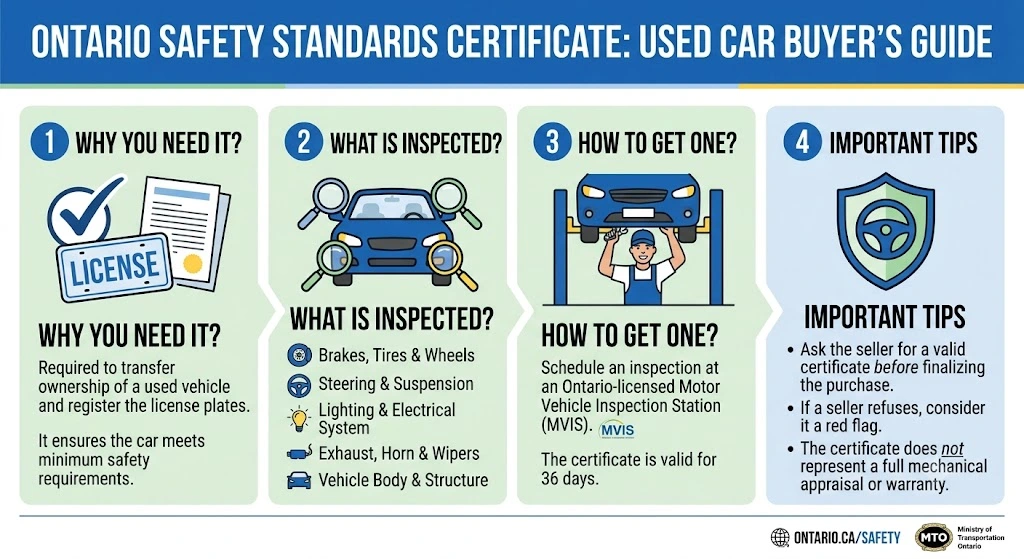
An Ontario Safety Standards Certificate (SSC) confirms a vehicle met the province’s minimum safety standards on the day it was inspected. You can buy and register a used car without one, but you cannot put licence plates on it without a valid certificate when you’re transferring ownership from a non-spouse. It’s valid for 36 calendar days, costs roughly $60–$150 for most cars (repairs extra), and can only be issued by a licensed DriveON Vehicle Inspection Centre. Important: it is not a warranty or a guarantee of the car’s condition.
If you’re buying or selling a used vehicle in Ontario, the Ontario Safety Standards Certificate is one of those documents that causes more confusion than almost anything else in the process. Do you need one? Who pays for it? How long does it last? What if the car fails? After years of getting cars certified and on the road for buyers here in Oshawa, let me walk you through exactly how it works — in plain English, with the current rules — so you don’t get caught out at the registration counter.
This is general information to help you understand the process. Rules can change, so always confirm the current requirements on the official Ontario government website before you buy or sell.
What is a Safety Standards Certificate?
A Safety Standards Certificate is an official document confirming that a vehicle met Ontario’s minimum safety standards at the time it was inspected. It’s issued only after the car passes a formal safety inspection at a licensed inspection centre.
Here’s the single most important thing to understand, and the part people most often get wrong: an SSC is not a warranty and it does not guarantee the car’s overall condition or future reliability. It’s a snapshot of one moment in time — the day of the inspection. A car can pass its safety and still develop problems next week. That’s why a smart buyer treats the certificate as a starting point, not a substitute for their own due diligence.
Do you actually need a Safety Standards Certificate?
This is where the confusion lives, so let’s be precise. You can buy and even register a used vehicle without an SSC — but you cannot get licence plates for it without one in the situations below. No plates means you can’t legally drive it on the road.
You need a valid Safety Standards Certificate when:
- You’re transferring ownership of a used vehicle to or from someone who is not your spouse — this covers most private sales.
- You’re registering an imported vehicle brought in from another province, territory, or country.
- You’re registering a rebuilt vehicle.
- You’re changing a vehicle’s status from “unfit” to “fit.”
You don’t need one when:
- You’re transferring the vehicle to your spouse — spousal transfers are exempt.
- You’re buying the car but not yet plating it (you can register it “as-is” and get the certificate later, within reason).
One thing that trips up newcomers to Ontario: a safety inspection from another province is not accepted here. If you’re bringing a car in from elsewhere, you’ll need a fresh Ontario certificate before you can plate it.
What gets inspected?
A safety inspection is a thorough, standardized check of the systems that keep you safe on the road. Inspectors assess, among other things:
- Brakes — including the parking brake (brake lining that’s worn to roughly 1.6 mm or less will fail).
- Tires — condition and tread depth (a minimum tread of about 2 mm is required).
- Steering and suspension — for wear, play, and damage.
- Lights and signals — headlights, brake lights, indicators.
- Windshield and wipers — a crack in the driver’s line of sight must be repaired or replaced to pass.
- Exhaust system — leaks here are a safety issue (carbon monoxide) and a fail.
- Structural integrity — the body and frame, with attention to serious rust.
- Fluid leaks and other safety-related components.
Minor cosmetic issues — a small surface rust spot, a little dent — generally won’t fail a car. It’s the safety-critical wear that matters.
How much does an Ontario safety certificate cost?
Pricing is not set by the government, so it varies from shop to shop. As a rough guide:
- Most cars and SUVs: about $60–$150.
- Trucks and larger vehicles: more, because there’s more to inspect — often $120–$200+.
- Re-inspection after repairs: some shops include it; others charge a smaller fee.
Two honest cautions. First, that fee covers the inspection only — any repairs needed to bring the car up to standard are extra, and they can add up on a neglected vehicle. Second, it’s worth calling two or three centres to compare, since prices genuinely differ.
How long is a Safety Standards Certificate valid?
36 calendar days from the date of inspection. That’s the rule to circle. If you don’t register and plate the vehicle within those 36 days, the certificate expires and you’ll have to pay for a brand-new inspection. So don’t get the safety done weeks before you’re ready to register — line it up close to your registration date.
Where do you get one?
Only a DriveON Vehicle Inspection Centre licensed by the Ministry of Transportation can issue a Safety Standards Certificate. (These were formerly known as Motor Vehicle Inspection Stations.) Most independent mechanics and chain auto shops hold this licence, so they’re not hard to find.
A genuinely useful, lesser-known tip: you can look up a vehicle’s safety inspection history by its VIN through the public DriveON portal. That lets you confirm a real, valid certificate exists — protecting you from a fraudulent or altered paper one. Always match the VIN on the certificate to the VIN on the vehicle and the ownership.
Safety certificate vs. UVIP vs. emissions — clearing up the confusion
These three get mixed up constantly, so here’s the difference:
- Safety Standards Certificate — confirms the car meets minimum safety standards; needed to plate it in the situations above.
- Used Vehicle Information Package (UVIP) — a separate document the seller is legally required to provide in a private sale. It’s about the car’s history and lien status, not its safety.
- Emissions testing — Ontario ended mandatory emissions tests for light passenger vehicles back in 2019, so for most cars this no longer applies. A safety inspection is a completely separate thing.
Buying from a dealer vs. a private seller
This is where buying from a registered dealership genuinely saves you hassle. When you buy from an OMVIC-registered dealer, the vehicle is normally sold certified — meaning the safety is already handled and included — unless it’s explicitly advertised and sold “as-is.” A dealer must disclose that clearly.
Buy privately, and the safety becomes your problem: you’ll either negotiate for the seller to provide a valid certificate or buy the car as-is and take on the cost and risk of getting it certified yourself — including any repairs it needs to pass.
At Brownboys Motorclub, every vehicle we sell is inspected, certified, and backed by a full history report, so you’re not left sorting out safeties and surprises on your own. If you’d like to understand the wider process, our guides on how to find the best used cars in Oshawa and choosing a trusted dealership are worth a read, and our used car maintenance schedule helps you keep a certified car in good shape afterward.
Tips to help a car pass its safety
If you’re getting a vehicle certified yourself, a few things commonly cause a fail — and they’re worth checking first:
- Worn brakes near the minimum lining thickness.
- Tires below the tread minimum or with damage.
- A cracked windshield in the driver’s view.
- An illuminated check-engine light, which will usually cause a fail.
- Exhaust leaks and burnt-out lights.
Fixing these before the inspection is almost always cheaper and less stressful than a failed test and a return trip.
Frequently asked questions
Do I need a safety certificate to buy a used car in Ontario? You can buy and register a car without one, but you can’t put licence plates on it without a valid Safety Standards Certificate when transferring ownership from a non-spouse. In practice, you need one to legally drive it.
How long is an Ontario Safety Standards Certificate valid? 36 calendar days from the inspection date. If it expires before you register the vehicle, you’ll need a new inspection.
How much does a safety certificate cost in Ontario? Pricing isn’t regulated, so it varies — roughly $60–$150 for most cars and more for larger vehicles. Any repairs needed to pass are extra.
Does a safety certificate guarantee the car is in good condition? No. It confirms the vehicle met minimum safety standards on the inspection day only. It’s not a warranty, so always inspect a used car thoroughly before buying.
Do I need a safety certificate if I’m giving my car to my spouse? No. Spousal ownership transfers are exempt from the Safety Standards Certificate requirement.
Where can I get a Safety Standards Certificate? At any DriveON Vehicle Inspection Centre licensed by the Ministry of Transportation — most independent and chain repair shops qualify.
For the official rules and to look up a vehicle’s inspection history by VIN, see the Government of Ontario’s Safety Standards Certificate page at ontario.ca.
Skip the safety-certificate hassle
Every car at Brownboys Motorclub comes inspected, certified, and ready to plate — no chasing down inspections or surprise repairs. Browse our current inventory or get in touch with our team, and drive away with confidence. That’s the Brownboys Motorclub difference.